

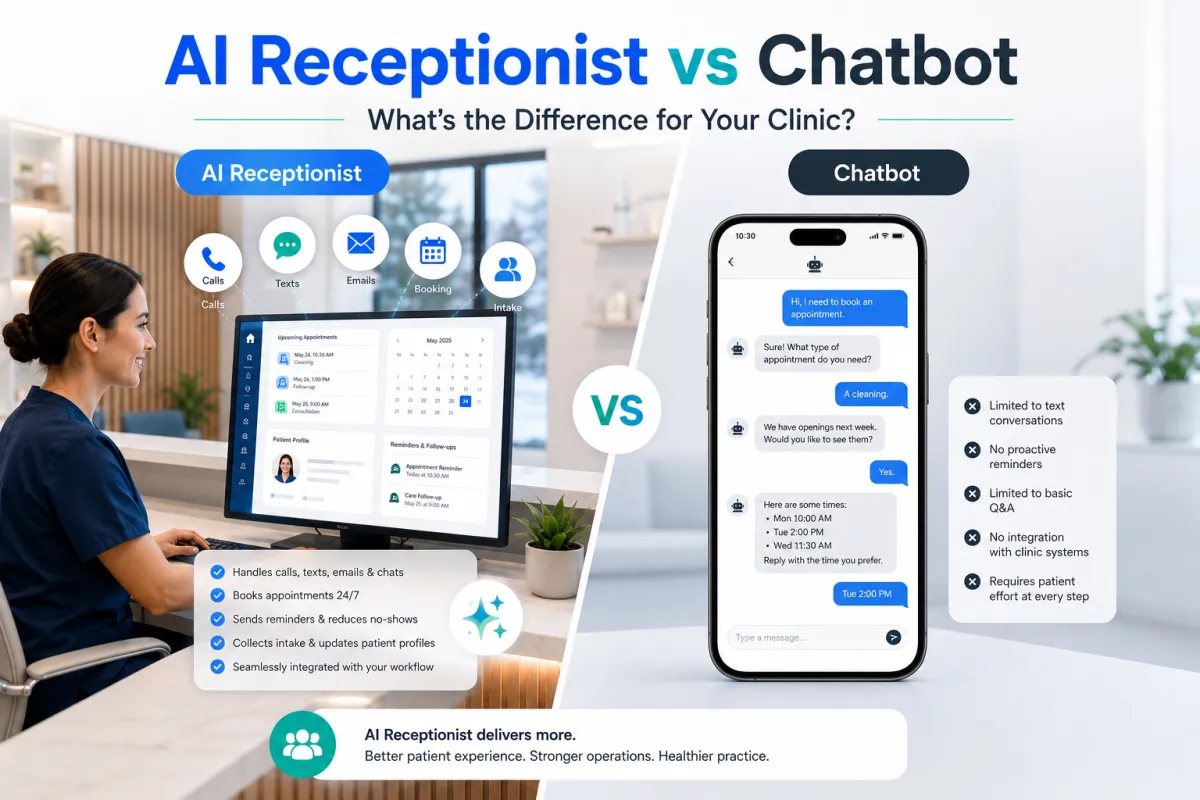
AI Receptionist vs Chatbot: What's the Difference for Your Clinic?
TL;DR: Key Facts
An AI receptionist answers phone calls with a conversational voice, handles patient questions, and books appointments into your calendar.
A chatbot exchanges text messages with visitors on a website or messaging app. It cannot answer a phone call.
The core difference is channel: voice for the AI receptionist, text for the chatbot.
Voice matters for clinics because most high-value patient contact still happens by phone, especially new-patient inquiries.
Many clinics end up using both: an AI receptionist for the phone line and a web chat tool for site visitors. They solve different gaps.
What Is the Difference Between an AI Receptionist and a Chatbot?
An AI receptionist is voice software that answers telephone calls; a chatbot is text software that replies to typed messages. The AI receptionist handles a live, spoken conversation on your clinic's phone line. The chatbot handles a typed exchange in a chat window, usually on your website.
That channel difference drives everything else: who each tool reaches, what it can handle, and what happens when it fails.
An AI receptionist answers inbound phone calls with a natural voice.
A chatbot responds to typed messages in a chat window.
An AI receptionist books appointments during the call itself.
What Is an AI Receptionist?
An AI receptionist is software that picks up your clinic's phone calls, speaks with the caller in a natural voice, answers routine questions, and books appointments directly into your calendar. It works 24 hours a day, answers instantly, and never puts a caller on hold.
In a clinic, it typically runs in one of two modes. Overflow mode means your team answers as usual and the AI only picks up calls that would otherwise ring out: the lunch-hour rush, the 6:05 pm new patient, the Saturday caller. Always-on mode means the AI answers first and routes anything complex to your team with the caller's name, number, and reason for calling already captured.
Vendors label this tool a few different ways. AI voice receptionist and AI phone receptionist both describe the same call-answering software. A medical office virtual receptionist can mean something different: sometimes it's AI, and sometimes it's a remote human answering your calls from another location, billed per call or per minute. Check which one a vendor is selling, because the coverage and cost models differ.
What Is a Chatbot?
A chatbot is software that holds a typed conversation, usually through a chat widget on a website or inside a messaging app. A visitor types a question, the bot replies in text, and the exchange continues on screen.
Chatbots range widely in quality. Older rule-based bots follow rigid decision trees ("type 1 for hours"), while modern AI chatbots hold open conversation and work well for website visitors browsing services or checking basic information before they commit to calling.
What no chatbot can do is answer your telephone. If a patient dials your clinic, a chat widget on your website never enters the picture.
Why Does Voice vs Text Matter for a Clinic?
Voice matters because the phone is still where clinics win or lose patients. A new patient with an urgent problem, an older patient uncomfortable with typing, a parent calling from the car: these people phone. They don't open your website and start typing into a widget.
The two channels also fail differently. When a chatbot has no answer, the visitor is already on your website and can click around or fill in a form. When a phone call goes unanswered, the caller hears voicemail and often dials the next clinic on the search results. The phone failure costs more, which is why the phone deserves the more capable tool.
Text has its own strengths. It suits quiet browsing, quick fact-checks, and visitors who aren't ready to talk to anyone yet. That's a real audience; it's just a different one from your callers.
Can a Chatbot Answer Your Clinic's Phone?
No. A chatbot operates in text channels only, so a ringing phone line is outside its reach entirely. Some vendors blur this line by marketing text tools with phone-sounding names, which is where much of the confusion starts.
The reverse is also true in most cases: a voice AI receptionist is built for the phone line, not for your website's chat window. Some platforms pair the two. HiClinic, for example, offers the AI Receptionist for calls and a Talking Website tool for site visitors, as two parts of one front-office layer rather than one tool stretched across both jobs.
If a vendor claims one product does both, ask which channel it was actually built for. The answer usually shows in the demo.
Which One Can Book Appointments?
Both can, but the bar to check is whether the tool books in real time or just takes a message. A capable AI receptionist books the appointment into your calendar while the caller is still on the line, matched to the right provider and appointment type. A capable chatbot can do the equivalent on screen, letting a visitor pick a slot in the chat window.
The weaker versions of both tools do something that only looks similar: they collect contact details and leave your team a callback task. That's message-taking, not booking, and it recreates the phone-tag problem these tools exist to remove. Whichever channel you're evaluating, test whether a real appointment lands in a real calendar without a human touching it.
AI Receptionist vs Chatbot: Side-by-Side

Does Your Clinic Need an AI Receptionist or a Chatbot?
Match the tool to where you're losing patients. If your missed-call log is the problem (lunch hours, after-hours callers, a front desk that can't reach the phone during check-in), you need an AI receptionist, because that's the only tool of the two that touches your phone line. If your website gets traffic that leaves without booking, a chat tool addresses that gap.
Many clinics eventually run both, since the phone and the website attract patients in different ways. But if you're choosing one first, start with the channel that's bleeding: for most clinics, that's the phone. A patient already dialling your number carries higher intent than a visitor skimming your homepage, and the missed-call math tends to settle the priority quickly.
And if your shortlist includes a human-staffed virtual medical receptionist service, run the same booking test: instant answer, real appointment in a real calendar, and a cost that doesn't climb with call volume.
Either way, the tool should sit alongside your existing systems. HiClinic's AI Receptionist works as a front-office layer next to platforms like Jane App and OSCAR, so nothing about your scheduling, charting, or billing setup moves.