

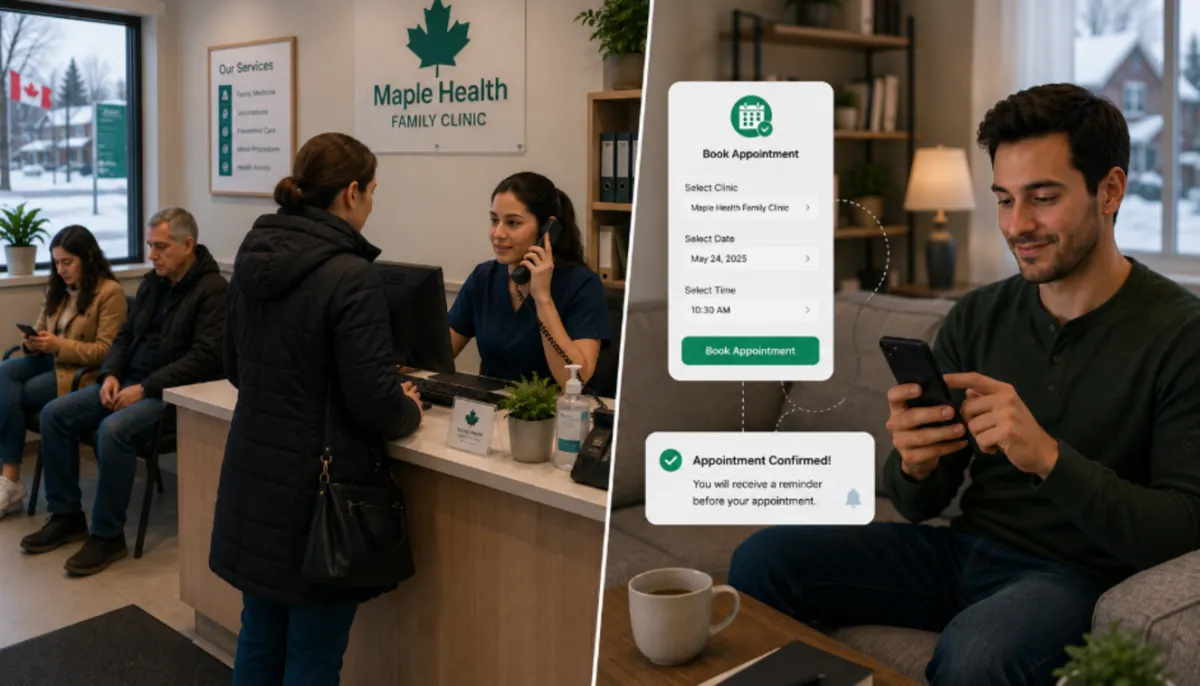
AI Receptionist vs Human Receptionist: What's Best for Your Clinic?
Every clinic reaches a point where the phone becomes a problem. A patient calls to book an appointment. The front desk is occupied by someone standing at the counter. The call goes unanswered. The patient hangs up and calls the next clinic on their list.
This happens dozens of times a week in clinics across Canada, and most owners never see it on a report because there is no report to see. The patient simply disappears.
The question of whether to invest in an AI receptionist for your medical office or maintain a human-only front desk is no longer a futuristic debate. It is a practical decision that directly affects your new patient volume, your staff workload, and your monthly revenue.
This blog breaks down both options honestly so Canadian clinic owners can make an informed choice.
What Is an AI Receptionist?
An AI receptionist is a software system that handles patient communication automatically, answering calls, responding to messages, booking appointments, answering common questions, and following up with patients without requiring a human to be present.
Modern AI voice receptionist technology for healthcare goes well beyond the basic phone trees of ten years ago. Today’s systems understand natural language, respond conversationally, handle after-hours inquiries, and integrate directly with clinic scheduling tools.
For Canadian clinics specifically, an automated medical receptionist means a patient calling at 9 pm on a Friday gets an immediate, helpful response rather than a voicemail they will probably not leave.
What Is a Human Receptionist?
A human receptionist brings empathy, contextual judgment, and relationship-building that no software fully replicates. They can read tone, notice when a patient seems distressed, handle genuinely complex or sensitive situations, and represent your clinic’s personality in a way that feels personal.
For high-volume Canadian clinics, however, human receptionists face real structural limitations: they can only handle one call at a time, they are unavailable outside working hours, they take sick days, and their cost scales linearly with demand. Every additional receptionist is a fixed monthly expense regardless of how many calls actually come in.
How Does an AI Receptionist Handle Patient Inquiries Compared to a Human?
This is the question most clinic owners have when they first consider AI voice receptionist technology for healthcare. The honest answer is different, not worse.
An AI receptionist handles routine inquiries faster and more consistently than a human can. Appointment bookings, hours of operation, directions, cancellations, rescheduling, and common clinical FAQs — all of these can be handled instantly, around the clock, without placing the patient on hold.
Where a human receptionist genuinely outperforms AI is in situations requiring judgment that goes beyond the data. A patient who sounds distressed, a complex insurance question, or an urgent clinical concern that needs immediate escalation, these benefit from a human who can read the room.
The practical answer for most Canadian clinics is not either/or. It is a model where AI handles the volume and the after-hours load, while your human team focuses their attention on the moments that genuinely require human presence.
What Are the Advantages of an AI Receptionist Over a Human?
For Canadian medical clinics dealing with missed calls, AI front desk clinic solutions offer several specific advantages:
No missed calls after hours. Research consistently shows that a significant portion of new patient inquiries happens outside business hours. An AI receptionist answers every one of them. Combined with auto missed call text-back feature, no inquiry simply disappears into voicemail.
Consistent patient experience.A human receptionist has good days and bad days. An AI receptionist delivers the same response quality on a Monday morning and a Friday afternoon.
Cost efficiency at scale.A single AI medical receptionist software deployment handles the call volume that would otherwise require two or three additional staff members. For growing clinics, this is a meaningful difference in monthly overhead.
Reduced front desk pressure.When routine calls are handled automatically, your human staff have more time for the patients standing in front of them, which is where their attention should be.
What Are the Limitations of Using an AI Receptionist Instead of a Human?
Fairness requires acknowledging what AI cannot do well yet.
Sensitive conversations, a patient calling about mental health concerns, a child’s medical situation, or a complaint about care quality — benefit from a human voice that can offer genuine empathy. AI systems can be programmed to escalate these situations to staff, but the initial interaction still feels different.
There is also a segment of Canadian patients, often older, who prefer speaking with a person and find automated systems frustrating. A good AI receptionist implementation accounts for this with clear escalation paths to human staff.
The solution most Canadian clinics are finding is a hybrid model: AI handles volume, consistency, and after-hours coverage; human staff handles complexity, sensitivity, and relationship-building.
What Are the Costs of an AI Receptionist Versus a Human Receptionist?
A full-time human receptionist in Canada costs between $38,000 and $52,000 per year in salary alone, before benefits, training, sick days, and turnover costs are factored in. Most clinics need more than one to cover hours adequately.
AI medical receptionist software for Canadian clinics typically runs at a predictable monthly subscription, a fraction of one staff salary, and covers unlimited call volume around the clock.
For a clinic processing 30 to 80 calls per day, the economics of AI voice receptionist healthcare technology become very clear very quickly.
Privacy and Compliance for AI Receptionists in Canadian Healthcare
This is a valid concern for any Canadian clinic considering AI front desk solutions. Patient communication in Canada is governed by provincial privacy legislation and PIPEDA. Any AI receptionist system used in a Canadian medical setting must handle patient data securely and in compliance with applicable regulations.
HiClinic is built specifically for the Canadian healthcare market, with data handling designed around Canadian privacy requirements. You can review our approach on the HiClinic privacy policy page .
What Industries Benefit Most From AI Receptionists?
Within healthcare, the clinic types that see the largest gains from AI voice receptionist technology are those with high call volumes and consistent routine inquiry patterns:
Physiotherapy, chiropractic, dental, naturopathic, optometry, medical aesthetics, and family medicine practices all deal with the same categories of calls repeatedly appointment bookings, cancellations, hours, directions, and rescheduling. These are exactly the interactions AI handles best.
Multi-location clinic groups see compounding benefits, since AI covers every location simultaneously without proportional staffing increases.
How Can Clinics Transition From Human to AI Receptionists?
The transition does not have to be abrupt. Most Canadian clinics implement AI as an addition to their existing front desk team rather than a replacement for it.
A typical rollout looks like this: AI handles after-hours calls immediately. Over the following weeks, it takes on an overflow during peak hours. Within a month, the front desk team is no longer managing routine call volume; they are focused on in-clinic patients and complex inquiries.
HiClinic’s AI Receptionist is built for exactly this kind of phased implementation. Setup takes days, not months, and the system integrates with your existing workflow rather than requiring you to rebuild around it.
Pair it with patient recall automation to re-engage inactive patients automatically, and Google Review Automation to build your online reputation, and you have a system that handles the full patient communication cycle without adding headcount.
The Future of AI Receptionists in Healthcare
AI voice receptionist technology for Canadian healthcare is not a trend heading toward mass adoption someday. It is already being deployed by clinics across BC, Ontario, and Alberta right now.
The clinics that implement these systems today are building operational advantages that compound over time: lower overhead, higher call conversion, stronger patient retention, and front desk teams that focus their energy where it genuinely matters.
The technology will continue to improve. The case for starting now, rather than waiting for a more perfect version, is straightforward: every month of missed calls, overwhelmed front desk staff, and after-hours inquiries going unanswered is revenue and patients that do not come back.
Book a free demo to see how HiClinic’s AI Receptionist works for your specific clinic type.
Disclaimer
Disclaimer: The content shared by HiClinic is intended for informational and educational purposes only. It is not medical advice, legal advice, or clinical guidance. HiClinic provides automation tools designed to improve patient communication, scheduling, retention, and operational workflows. Results may vary depending on clinic size, processes, and implementation.