

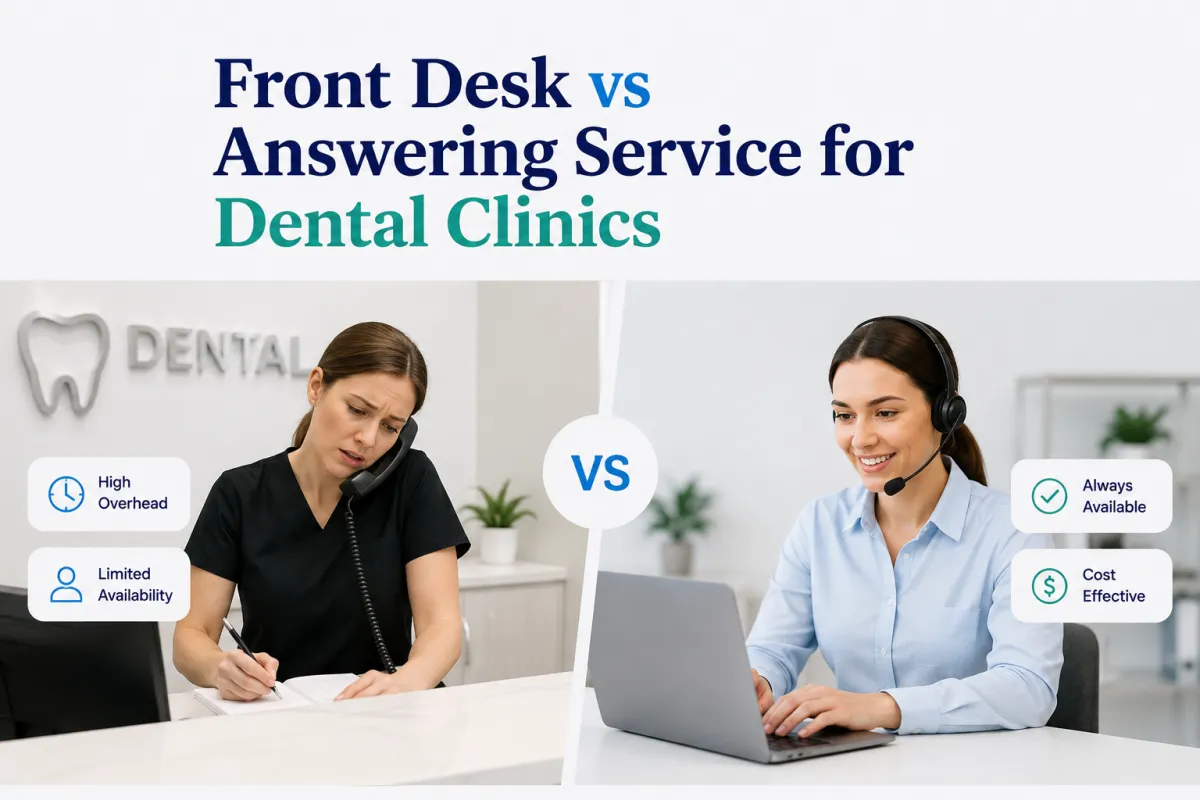
Front Desk vs Answering Service for Dental Clinics
TL;DR
A dental front desk handles in-person flow, clinical coordination, and judgment calls that require context and continuity. An answering service takes calls and takes messages, nothing else.
Most dental clinics lose bookings not because callers can't reach a human, but because the human is already with a patient.
A third option sits between the two: an AI receptionist answers calls and texts, books appointments in real time, and routes anything requiring judgment to your team.
"AI dental assistant" is a regulated clinical title in Canada. This post uses "AI receptionist" throughout, which is accurate to what the software does: front desk work, not clinical work.
HiClinic setup takes 7 days, training takes 30 minutes, and billing runs month to month.
The real problem: your front desk already works
Before comparing options, it helps to name the actual problem. Most dental front desks are not understaffed. They are doing three things at once: checking a patient in, answering a hygiene question from a colleague, and watching a call ring through to voicemail.
The lost bookings happen in that third moment. The caller who hits voicemail at 10 AM on a Tuesday is not a caller who will leave a message and wait. They dial the next clinic.
That is the problem all three options below are trying to solve, with very different success rates.
Comparison: Front Desk vs Answering Service vs AI Receptionist

What does a dental front desk coordinator actually do?
A dental front desk coordinator manages appointment scheduling, patient check-in, insurance verification, treatment plan coordination, payment collection, and the clinical communication that holds the day together.
That last item is the one no external service replaces. The coordinator knows that a patient on the 11 AM chair has dental anxiety and needs a quieter handoff. They know the hygienist is running 10 minutes late and the 11:30 patient needs a heads-up call. They know the treatment plan discussed last visit and can pull the file when the patient calls with a question.
Key Points:
A dental front desk coordinator manages scheduling, check-in, and insurance verification.
The coordinator communicates clinical context between staff and patients.
In-house staff retain continuity of patient history and relationships.
The answering service and the AI receptionist both lack this. Neither replaces the coordinator. They handle specific situations where the coordinator is otherwise occupied.
What does a dental answering service actually do?
A dental answering service answers inbound calls after hours or when the front desk is busy, takes a message, and passes it on according to a script your clinic provides.
What it does not do: book appointments in real time, answer questions that fall outside the script, respond to text or web chat, or follow up autonomously. The caller reaches a human voice, which is a real advantage over voicemail, but the interaction ends at message-taking.
Key Points:
A dental answering service answers inbound calls using a clinic-provided script.
Answering services pass messages to the clinic rather than booking appointments.
Answering services do not respond to text messages or web chat.
The answering service is the right fit for a specific scenario: a clinic that needs a warm after-hours voice, has no urgent same-day appointment volume, and whose patients are comfortable waiting for a callback. Those clinics exist. They are not typical.
What does an AI receptionist do for a dental clinic?
An AI receptionist answers every call and text, replies to web enquiries, and books appointments into the live calendar without a staff member picking up.
HiClinic's AI receptionist handles the mechanics of booking: what appointment type, which provider, what availability, confirmation. It routes anything requiring judgment, clinical context, or complaint handling to your coordinator with the full conversation attached. It does not access clinical records, discuss treatment options, or advise on dental symptoms.
Key Points:
HiClinic's AI receptionist answers dental clinic calls, texts, and web enquiries.
The AI receptionist books appointments into the live calendar in real time.
Clinical questions and complaints route to staff with full conversation history.
What does the AI receptionist not do at a dental clinic?
It does not give dental advice, interpret symptoms, access patient records, or perform any function that requires a licensed clinical or administrative judgment call. "AI dental assistant" is a regulated title in Canada; the product is an AI receptionist, which handles front-of-house logistics.
Which option fits which dental clinic?
The right answer depends on where your clinic loses bookings right now, not on which option sounds most advanced.
An in-house front desk coordinator fits when:
Your clinic has enough volume to justify the salary and overhead
Clinical coordination and patient continuity are daily requirements
You have the capacity to hire and train without a gap in coverage
A dental answering service fits when:
Your primary gap is after-hours calls, not daytime missed calls
Your patient base expects a human voice and will leave a message and wait
You have a coordinator who can return all messages the next morning without losing bookings
An AI receptionist fits when:
Calls are being missed during business hours, not just after hours
Text messages, web enquiries, and social messages are arriving in multiple places
You want real-time booking rather than a callback process
You want month-to-month flexibility rather than a long-term contract
Key Points:
A dental answering service covers after-hours calls with a human voice.
An AI receptionist books appointments in real time across call, text, and web.
HiClinic operates on a month-to-month billing model with no long-term contract.
How does real-time booking change a dental practice?
Real-time booking removes the callback step from the booking process. A caller who picks an appointment time and receives a confirmation in the same conversation is a booked patient. A caller who leaves a message and waits for a callback has two more chances to book somewhere else.
This matters most for new patient enquiries, which are the calls most likely to come in during the middle of a busy morning, and the calls most likely to go to a competitor if they hit voicemail.
For existing patients, the pattern is similar. A patient who texts at 7 PM about a follow-up appointment either books through the conversation or books with whoever replies first the next morning.
What about after-hours dental emergency calls?
After-hours emergency calls require a clear protocol that the answering service or AI receptionist handles within a defined scope, and routes to the on-call practitioner or emergency line for anything clinical.
No automated system or answering service should manage a dental emergency beyond capturing the contact information, communicating clearly that the caller's need has been registered, and directing them to an emergency line or after-hours protocol if one exists.
For HiClinic, after-hours emergency calls get an immediate acknowledgement and follow the routing your clinic configures during setup, which includes an escalation path for urgent contacts.
Can an AI receptionist improve dental patient reviews?
A dental AI receptionist can send automated follow-up messages after an appointment, which some clinics use to invite feedback or direct patients toward a review platform.
Whether that is appropriate depends on your provincial dental college's advertising and testimonial guidelines. Soliciting reviews via automated messages is regulated differently for dentists than it is for general businesses in most Canadian provinces. Confirm what is permitted in your province before using any automated review request tool.
How does setup compare across the three options?
The setup gap matters most when coverage needs to be filled immediately. A resignation, a maternity leave, or an unexpected volume spike all create pressure to solve the problem before the next business day. A 7-day AI receptionist setup and a 30-minute training block address a different timeline than a recruiting process does.
Key takeaways
A front desk coordinator does clinical coordination, patient continuity, and the judgment calls an external service cannot replace.
A dental answering service covers after-hours voice calls and takes messages. It does not book, text, or follow up.
An AI receptionist answers every call and text in real time, books into the live calendar, and routes anything requiring judgment to your team.
The right choice depends on where your clinic is currently losing bookings.
HiClinic sets up in 7 days, trains in 30 minutes, and bills month to month.
Want to see where your clinic is currently losing bookings? Book a free demo and we will walk through a typical call flow at a dental clinic like yours.