

How Dental Practice Management Software Reduces No-Shows and Missed Calls in Canadian Clinics
A patient calls your front desk at 5:40 p.m. on a Friday. Nobody picks up, because the desk closed at 5:00 and the team is finishing chart notes in the back. The caller doesn't leave a voicemail. By Monday, they've booked a cleaning at the clinic two blocks over.
That single missed call is worth far more than the call itself. A new patient in a Canadian general dental practice represents thousands of dollars in lifetime value once you add up recalls, fillings, the occasional crown, and the family members they refer. Lose a few of those a month, and the math gets ugly fast.
No-shows and missed calls are the two quiet leaks in almost every clinic's schedule. Most owners treat them as the cost of doing business. They don't have to be. The right dental clinic management software in Canada closes both leaks without adding a single hour of front-desk labour, and this post walks through exactly how.
What a practice management system actually is
Before getting into no-shows, it helps to be clear on terms, because "practice management software" gets used loosely.
A practice management system is the software that a clinic runs its day-to-day operations on: scheduling, patient records, billing and insurance, charting, and communication. In dentistry, it's the layer that sits between your clinical work and your business. Think of it as the operating system for the front office and the chair.
Most Canadian dental clinics already run some form of it. The big charting and billing platforms (names like Dentrix, Tracker, ABELDent, and Cloud 9) handle the clinical and accounting side well. Where many of them fall short is patient communication: answering the phone when the desk can't, texting a reminder before the appointment, and recovering a call that went unanswered. That communication gap is where most no-shows and missed-call losses actually happen.
So when someone asks "what software does a dentist use," the honest answer is usually two things: a clinical or charting system for treatment and billing, plus a communication and scheduling layer that keeps the calendar full. This post is about the second layer, because that's the one that moves the no-show and missed-call numbers.
What no-shows and missed calls really cost a Canadian clinic
It's easy to wave away a no-show as a minor annoyance. Run the numbers, and it stops being minor.
Say your average appointment is worth $200 in production, and you lose six appointments a week to no-shows and last-minute cancellations, you couldn't refill. That's $1,200 a week, roughly $5,000 a month, around $60,000 a year of production walking out the door, much of it from chairs that sat empty while a hygienist was on the clock.
Now add the missed calls. Industry data on appointment-based businesses consistently shows that a meaningful share of inbound calls go unanswered during rush periods, lunch, and after hours, and that callers rarely leave a voicemail before trying the next clinic. A handful of unanswered new-patient calls a week, each representing the full lifetime value of a patient, compounds into a number most owners would rather not see written down.
The frustrating part is that almost none of this is a clinical problem. The dentistry is fine. The leak is operational: a phone that rings out, a reminder that never went out, an open slot nobody knew to refill.
How the right software fixes it
Good dental practice management software treats the schedule as something to actively protect, not just display. Four features do most of the work.
Automated appointment reminders
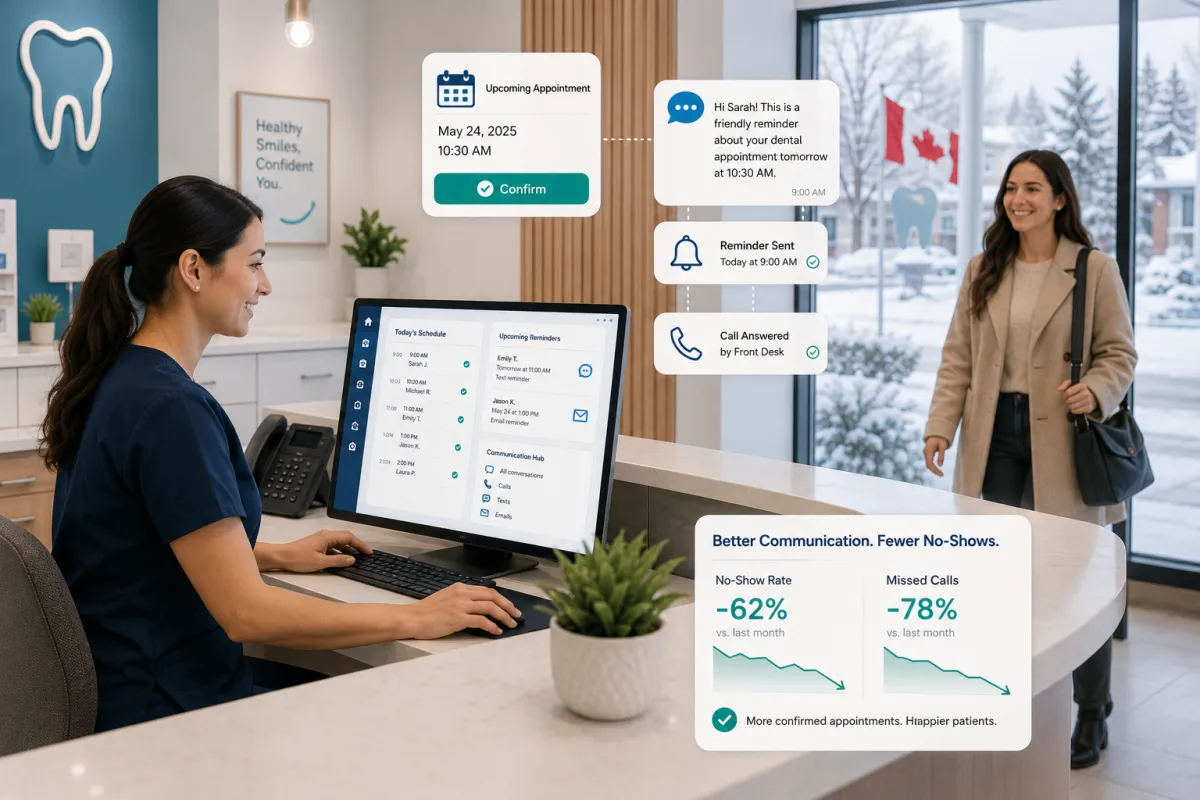
The single biggest lever on no-shows is reminding people, on the channel they actually read. Automated reminders go out by text and email on a schedule you set: a confirmation at booking, a nudge a few days out, a final reminder the day before. Patients confirm with a tap, and the ones who need to reschedule do it before the chair sits empty rather than after.
This is unglamorous and extremely effective. Most of the no-show reduction in any clinic comes from reminders that fire reliably every time, without a staff member having to remember to send them.
Missed-call text-back and an AI receptionist
When a call goes unanswered, the worst outcome is silence. A missed-call text-back fixes that: the moment a call is missed, the system automatically texts the caller something like "Sorry we missed you, how can we help?" The conversation moves to text, where most people are happy to book, and the lead doesn't bleed over to the next clinic.
For calls you want answered live, an AI receptionist picks up when the desk can't, including evenings and weekends. It answers common questions, checks availability, and books the appointment during the call, then hands off cleanly to a human when the situation calls for it. The caller hangs up with a real time on the calendar instead of a voicemail nobody returns.
Online self-booking
Plenty of patients would rather book at 9 p.m. from their couch than call during business hours. A booking calendar on your site and in reminder messages lets them pick a real open slot themselves, with your rules and availability built in. Every appointment booked this way is one your front desk didn't have to field a call for, and one that doesn't depend on someone answering the phone.
Waitlist and rescheduling automation
When a cancellation does happen, the chair only stays empty if nobody fills it. Waitlist automation flags the opening and offers it to patients waiting for an earlier slot, often filling the gap the same day. Rescheduling tools let patients move themselves to another time instead of cancelling outright. The result is fewer empty chairs from the cancellations you can't prevent.
Put together, these four features attack the problem from both ends: they stop appointments from being missed in the first place, and they recover the revenue when a call or a slot slips through anyway.
What is the best dental practice management software for a Canadian clinic?
There's no single best dental software in Canada for every clinic, and any list that claims otherwise is usually selling something. The right choice depends on your size, your niche, and what you already run.
What matters more than any brand name is matching the software to your situation. A few things to weigh:
Canadian fit. You want a tool built with Canadian clinics in mind, which means handling patient data under PIPEDA and provincial privacy law, and ideally keeping that data in Canada. Compliance isn't optional in healthcare, so this should be a hard filter, not a nice-to-have.
The communication gap. If your charting and billing system already works, you don't need to rip it out. You need the layer it's missing: reminders, missed-call recovery, an AI receptionist, and online booking. Look for something that adds those without forcing a full migration, and that integrates with what you have.
Ease of use. Front-desk staff turnover, and a tool nobody can run, is a tool that quietly stops getting used. Set up measured in days, not months, and an interface that a new hire can learn in an afternoon both matter more than a long feature list.
Honest pricing. Predictable monthly pricing beats per-call or per-message billing that balloons in a busy month. For a small clinic, especially, you want to know the number before the invoice arrives.
Affordable options for small practices
Cost is the part that worries most independent owners, and reasonably so. A two-operatory clinic can't justify enterprise pricing built for a 12-location group.
The good news is that affordable dental practice management software in Canada exists and has gotten genuinely capable. The thing to look for in dental software for small practices in Canada is flat, predictable monthly pricing with the no-show and missed-call features included, rather than locked behind an enterprise tier.
HiClinic is one option built for exactly this. It's a Canadian platform that adds the communication layer (automated reminders, missed-call text-back, an AI Receptionist, online booking, and a Patients Pipeline to track everything) on top of clinics' existing systems, and it integrates with tools like Jane App. Pricing is month-to-month and transparent: CA$198/month for the Starter plan, CA$298/month for Growth, and CA$498/month for Pro with the AI Receptionist, with a 25% discount on annual billing and setup within about a week. One recovered no-show a week tends to cover the subscription several times over.
It won't be the right fit for every clinic, and you should compare a couple of options against your own numbers. But for a small or mid-size Canadian practice losing patients to missed calls, that's the category of tool that solves it.