

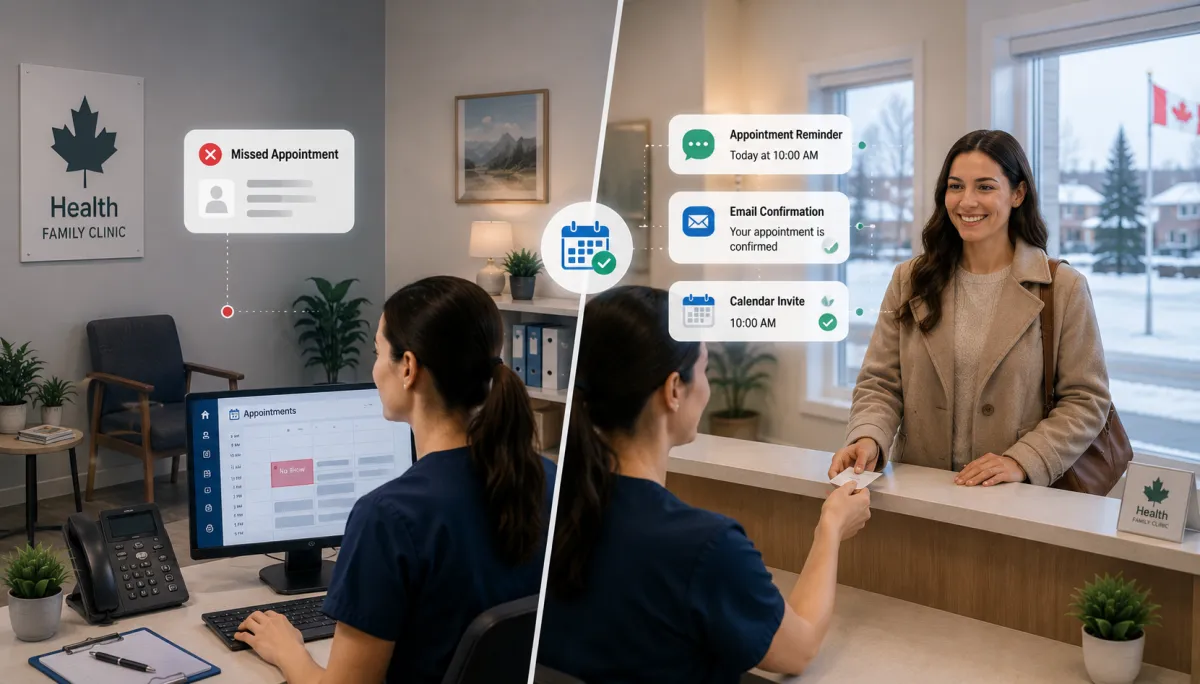
How to Reduce Patient No-Shows: Proven Strategies for 2026
A patient schedules an appointment. Your front desk builds the chart. The room’s ready. The provider waits. And no one walks through the door.
This happens every day in Canadian clinics. Across healthcare practices, the average no-show rate is 15% to 30%. That means, on a busy day, one out of five booked appointments just vanishes. For a single-provider clinic seeing 30 patients a day at an average of $200 per visit, a 20% no-show rate results in about $1,200 in lost revenue every day, which is about $288,000 per year.
The good news is that no-shows are not inevitable. By consistently implementing the right strategies, practices can reduce their no-show rates by 40% or more.
This blog covers what actually works in 2026, the specific tactics, the technology, and how Canadian clinics are putting it all together.
What Impact Do No-Show Rates Have on Healthcare Practices?
Before exploring solutions, it’s important to understand the full cost. Lost appointment revenue is the most obvious cost, but the effects go beyond that.
Your staff still pulls the chart, prepares the room, and reserves provider time. That effort is wasted, whether the patient shows up or not. Over time, frequent no-shows create scheduling chaos, staff burnout, and a backlog that frustrates patients who are trying to get in. Clinics with high no-show rates often see poorer patient outcomes, especially for those managing chronic conditions that require regular follow-ups to stay on track.
There’s also the access issue. Each empty slot represents a spot that could have been filled by another patient in need of care.
Factors Contributing to Missed Patient Appointments
Effective solutions require a thorough understanding of the underlying issues. Research consistently identifies the following primary causes:
Forgetfulness
Forgetting accounts for 40% to 50% of all missed visits. A booking made three weeks in advance is easy to forget without a reminder.Scheduling Friction
Patients who cannot easily confirm, reschedule, or cancel appointments are more likely to miss them.Transportation and Logistics Barriers
Missed rides, shift conflicts, childcare responsibilities, and other logistical challenges often prevent patients from attending appointments.Cost Uncertainty
Patients who are unsure about treatment costs or outstanding balances may avoid the appointment rather than face an unexpected bill.Symptoms Improve Before the Visit
When patients start feeling better, they may decide the appointment is no longer necessary.Fear and Anxiety
Anxiety is especially common for dental visits, lab work, and mental health appointments, causing some patients to avoid showing up altogether.
Each root cause calls for a slightly different response. That is why a single tactic rarely moves the number meaningfully. The clinics that achieve 40% reductions are almost always using layered strategies that address multiple causes simultaneously.
What Are the Proven Strategies to Reduce Patient No-Shows by 40%?
1. Automated Appointment Reminders — The Foundation
Reminders are the single highest-impact starting point. A text message reminder sent at the right time has a 90% to 98% open rate and is typically read within three minutes. That alone separates it from every other communication channel.
But timing matters. A single reminder is far less effective than a sequence. The pattern that consistently performs best:
5 to 7 days before— initial notice giving patients time to reschedule if needed
1 to 2 days before— confirmation request
Morning of the appointment— a final, friendly prompt
Practices using a three-touch reminder sequence report 20% to 30% fewer no-shows compared to those sending a single message. Add two-way confirmation where the patient can reply “YES” to confirm or request rescheduling and you turn a passive message into an active commitment.
HiClinic’s patient recall and communication tools automate this entire sequence, so no appointment slips through without at least three touchpoints.
2. Make Rescheduling Effortless
This is counterintuitive but well-supported by data: making it easier to cancel actually improves your show rate.
When a patient has to call during business hours, wait on hold, and speak to a staff member just to reschedule, many of them simply do not bother, and the appointment becomes a no-show. When they can reply “R” to a text and get a list of alternative times, they reschedule instead. A cancellation gives you a chance to fill the slot. A no-show gives you nothing.
One-click rescheduling, self-service portals, and simple text-reply options all reduce friction, directly converting potential no-shows into rebooked appointments.
3. Automated Missed Call Recovery
Here is a gap that costs Canadian clinics more than most owners realise. A patient calls to book or confirm an appointment. Nobody answers. They do not leave a voicemail. They move on.
Research shows that 78% of patients book with the first practice that responds to them. If your clinic misses that call and has no automatic follow-up, the patient either goes to a competitor or simply does not book at all.
HiClinic’s auto-missed-call text-back sends an immediate reply the moment a call is missed, keeping the conversation alive and giving the patient a path to confirm or reschedule without having to call back during business hours.
4. Waitlist Management
Even with the best reminder system, some cancellations will happen. A strong waitlist system recovers 50% to 70% of those lost slots.
The key is speed. When a slot opens at 8 am, an automated message goes to waitlisted patients, and the first to reply claims the slot. Without automation, a staff member has to work through a list manually, by which time the morning is half gone, and the slot may sit empty anyway.
For a clinic averaging four cancellations per day at $200 per visit, recovering even half of those slots adds roughly $400 per day in revenue that would otherwise be lost.
5. Patient Education and Expectation Setting
Some patients miss appointments simply because they did not understand why it mattered. Telling a patient “we need to check your blood pressure and adjust your medication” is more compelling than “you have a follow-up scheduled.” Giving the visit a clear, specific purpose increases the likelihood that the patient treats it as non-optional.
Setting clear no-show policies at intake and including a brief reminder in confirmation messages also helps. Most patients respond reasonably to transparent expectations. A simple note like “if you need to reschedule, please let us know 24 hours in advance so we can offer that time to another patient” creates accountability without feeling punitive.
6. Open Access Scheduling
One of the most underused strategies in Canadian clinic management. Open access scheduling, also called same-day scheduling, keeps a portion of appointment slots available for patients who call that morning.
The logic is straightforward: a patient who books today for today is dramatically less likely to forget or have a conflicting commitment arise between booking and appointment. The longer the gap between when a patient books and when their appointment is, the higher the no-show risk. Open access collapses that window.
It works particularly well for primary care, walk-in clinics, and physiotherapy practices with consistent day-of demand.
How Can Communication Improve to Minimise Patient No-Shows?
The Multi-Channel Approach
No single channel reaches every patient. The practices that achieve the largest reductions use a layered approach:
SMS text— highest open rate, fastest response, ideal for short confirmations and reminders
Email—better for longer content: visit prep instructions, new patient forms, policy details
Phone calls— most effective for older patients, high-value visits, or patients with a history of missing appointments
Patient portal—creates a documented record of notification and gives patients a centralised place to manage their bookings
A well-structured sequence might look like this: text message seven days out, email three days before, text reminder the day before, and phone call the morning of if the patient has not yet been confirmed. This approach leaves very little room for an appointment to fall through the cracks.
How Does an AI Receptionist Reduce No-Shows?
A significant portion of no-shows begin as missed calls. The patient tried to confirm, reschedule, or ask a question, and nobody answered. HiClinic’s AI receptionist handles these conversations around the clock, answering common questions, processing rescheduling requests, and keeping patients engaged even when your front desk team is unavailable.
For clinics dealing with high call volumes or after-hours inquiries, this alone can meaningfully reduce the number of patients who fall through the gap between booking and appointment.
Are there specific technologies that can help reduce patient no-shows?
Yes, and the most effective ones in 2026 do several things simultaneously rather than solving just one piece of the problem.
The most impactful digital tools for reducing no-shows combine the following:
Automated multi-touch reminder sequences via SMS, email, and phone
Two-way communication that lets patients confirm or reschedule by replying to a message
Missed call recovery that follows up automatically when a call goes unanswered
Waitlist automation that fills cancelled slots immediately
Patient recall campaigns that re-engage inactive patients before they disappear entirely
HiClinic’s platform brings all of these together in a single system built specifically for Canadian clinics.
How Can Healthcare Providers Track and Analyse No-Show Rates Effectively?
You cannot improve what you are not measuring. Start by calculating your baseline no-show rate: divide the number of no-shows by total scheduled appointments and multiply by 100. Track this weekly and monthly.
Break it down by:
Day of the week and time of day
Appointment type
Provider
Booking lead time (how far in advance the appointment was booked)
This data tells you where the problem is most concentrated. If your Tuesday morning slots consistently show a 30% no-show rate but your Friday afternoons sit at 10%, you have specific information to act on, whether that means adjusting scheduling, increasing reminder touchpoints for certain slots, or implementing open access for high-risk windows.
Track these metrics monthly alongside revenue recovered from waitlist fills and reminder response rates. Small improvements compound quickly when you measure them consistently.
How do I schedule appointments to minimise no-shows?
Keep the gap between booking and appointment as short as clinically appropriate—longer lead times directly correlate with higher no-show risk
Reserve a portion of each day’s slots for same-day bookings
Use historical no-show data to apply light overbooking selectively to high-risk time slots
Confirm appointment type and patient preparation requirements at booking—a patient who knows what to bring and what to expect is more likely to arrive
Use your waitlist actively; treat every cancellation as a recoverable slot, rather than a lost cause.
What Incentives Can Be Offered to Patients to Reduce No-Shows?
A few approaches work well without damaging the patient relationship:
Priority scheduling— patients with strong attendance records get first access to the most convenient time slots
Deposit systems—for patients with a documented history of no-shows, a small deposit applied to their copay at attendance creates a financial stake without being punitive
Appreciation acknowledgement—a brief thank-you message after a visit costs nothing and builds the habit of positive engagement
Avoid using financial penalties as a first response. Applied too broadly, no-show fees create resentment and can drive away patients who had a genuine emergency. Reserve them for clearly established repeat offenders and always communicate the policy in writing before enforcing it.
How HiClinic Helps Canadian Clinics Reduce No-Shows
HiClinic was built by a practising Canadian physician and a 15-year digital marketing veteran specifically to solve the operational gaps that cost clinics patients. The platform combines the following:
Auto Missed Call Text-Back: Instant response when a call goes unanswered
AI Receptionist: 24/7 Handling of patient inquiries, confirmations, and rescheduling requests
Patient Recall Automation: Re-engages inactive patients before they disappear
Google Review Automation: Turns show-ups into reviews that build long-term trust
Clinic Websites: Fast, mobile-ready sites that make booking frictionless from the first visit
Book a free demo to see how HiClinic fits your clinic’s specific workflow.
Disclaimer
Disclaimer: The content shared by HiClinic is intended for informational and educational purposes only. It is not medical advice, legal advice, or clinical guidance. HiClinic provides automation tools designed to improve patient communication, scheduling, retention, and operational workflows. Results may vary depending on clinic size, processes, and implementation.