

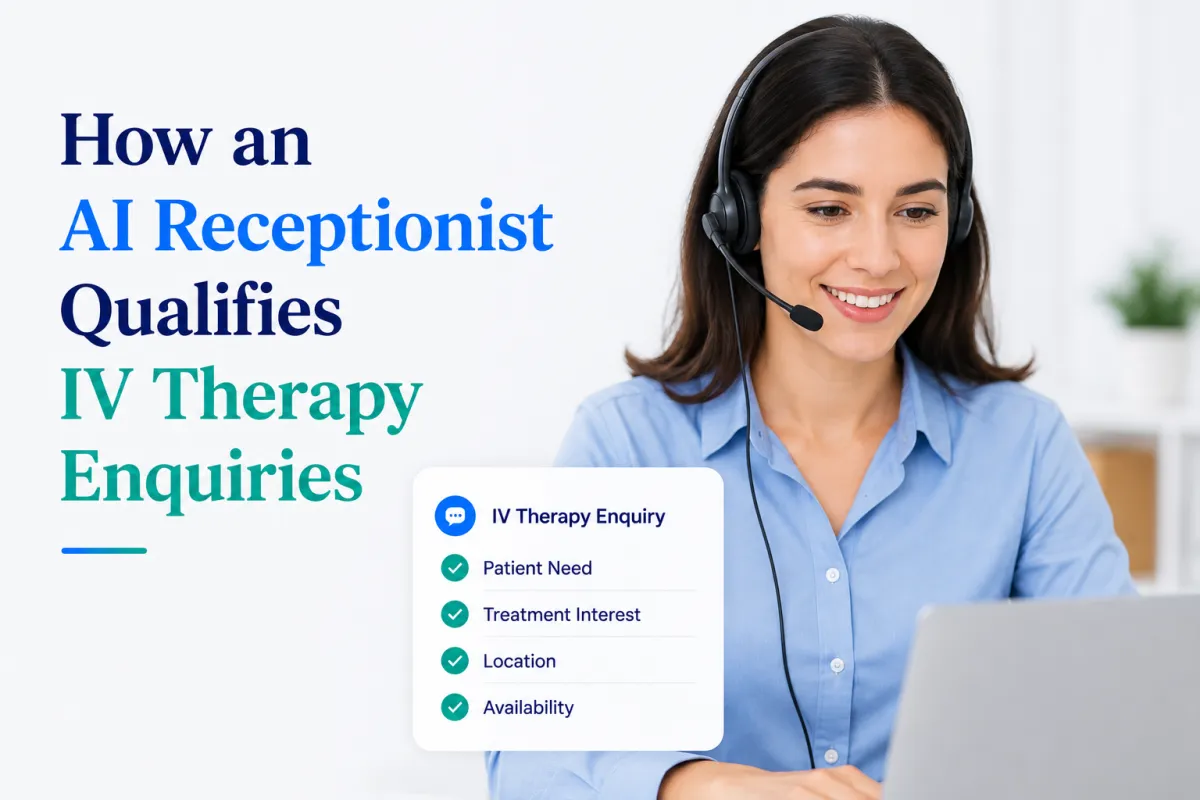
How an AI Receptionist Qualifies IV Therapy Enquiries
TL;DR
Qualifying an IV therapy enquiry means sorting it commercially: which service, new or returning, when they are free, in-clinic or mobile. It does not mean medical screening.
HiClinic answers calls, texts, and social messages, routes the enquiry to the right service, and books it into the live calendar.
Clinical suitability, contraindications, and health history stay with your nurse or physician. The AI receptionist never touches them.
Enquiries arriving after hours get an answer in seconds instead of a voicemail box.
Setup takes 7 days, staff training takes 30 minutes, and clinics see a first result within 48 hours.
Billing runs month to month with no long-term contract.
What does it mean to qualify an IV therapy enquiry?
Qualifying an IV therapy enquiry means establishing what the person wants to book, whether they have visited before, when they are available, and whether they need the clinic or a mobile visit. It is a scheduling decision, not a clinical one.
That distinction runs through everything below, so it is worth stating plainly. An AI receptionist qualifies an enquiry the way a well-briefed front desk coordinator does. It finds out enough to put the right appointment in the right slot with the right practitioner. It does not decide whether someone is a suitable candidate for a treatment.
Semantic triples:
HiClinic qualifies IV therapy enquiries on service, history, and availability.
HiClinic routes qualified enquiries to the matching appointment type.
Clinical suitability decisions remain with the clinic's licensed practitioners.
Can an AI receptionist route enquiries to the right service?
Yes. An AI receptionist routes IV therapy enquiries by matching what the caller describes against the service list your clinic configures during setup, then offering availability for that specific appointment type.
Routing works because the clinic defines the map, not the software. During setup you specify your services, how long each takes, which practitioners deliver them, and whether each is available in-clinic, mobile, or both. The AI receptionist reads that configuration and places the enquiry accordingly.
Where an enquiry does not match cleanly, it goes to your team rather than into a guessed slot. A caller who describes something ambiguous, asks for a service you do not offer, or raises a health question gets routed to a human with the conversation attached.
Semantic triples:
Clinics configure their service list and appointment durations during setup.
HiClinic matches enquiries against the configured service list.
Unmatched enquiries route to clinic staff with full conversation history.
What does the AI receptionist ask an IV therapy enquiry?
It asks four logistical questions: what service they want, whether they have visited before, when they are available, and whether they want to come in or book a mobile visit.
The full question set covers:
Service. Which drip or treatment on your configured menu they are asking about
History. New patient or returning, which changes what the clinic needs before the visit
Timing. Preferred days and times, matched against live calendar availability
Location. In-clinic appointment or mobile visit, where the clinic offers both
Group size. Whether they are booking for themselves or a group, which some clinics handle differently
Practicalities. Parking, duration, what to bring, where to find you
Notice what is absent. No health history. No questions about medications, conditions, or symptoms. No assessment of whether the service suits them. Those belong to the intake your practitioner runs, and putting them in a booking conversation would be both clinically wrong and a compliance problem.
What happens to an enquiry that arrives at 9 PM?
An enquiry arriving at 9 PM gets a reply within seconds, an answer to the routine question, and a live booking slot before the person moves on to the next clinic.
IV therapy enquiries cluster outside business hours more than most clinic verticals. People book around events, travel, and recovery days, and they research at night. A clinic that answers those enquiries the next morning is answering them after the decision has already been made somewhere else.
The reply arrives through whichever channel the person used. Calls, texts, website chat, and social messages land in one inbox instead of scattering across four apps that nobody checks after closing.
How does a missed call turn into a booking?
A missed call triggers an automatic text back within seconds. The caller receives a message while your nurse is still with a patient, and that text opens a conversation the AI receptionist carries through to a confirmed appointment. The alternative is a voicemail nobody returns until tomorrow.
How does a qualified enquiry move through the patient pipeline?
A qualified enquiry enters the pipeline as a named stage, moves as the person responds, and either converts to a booked appointment or sits in follow-up rather than disappearing.

The operational gain is visibility. Most small clinics lose enquiries in the gap between "someone messaged us" and "someone booked," because that gap lives in a staff member's memory. A pipeline stage makes it a thing you can see and work.
What happens after the appointment is booked?
After booking, the system sends a confirmation, a pre-appointment reminder, and post-visit follow-up on the schedule your clinic sets.
Reminders matter more for IV therapy than for many verticals because appointments run long and chairs sit empty when someone forgets. A confirmed slot that no-shows costs the chair time, the practitioner's time, and the supplies prepared for it.
Post-visit follow-up is where clinics choose their own approach. Some send a simple check-in. Some invite feedback. Some ask for a review. What is appropriate depends on your regulatory position, particularly if your clinic operates under physician direction.
Which questions must stay with clinical staff at an IV therapy clinic?
Anything involving health history, contraindications, medications, suitability for a treatment, dosing, or what a therapy does physiologically must stay with your licensed practitioners.
Out of scope for the front desk layer:
Suitability. Whether a person is a candidate for any service you offer
Health history. Conditions, medications, allergies, pregnancy, recent procedures
Contraindications. Any reason a treatment should not proceed
Clinical content. What a formulation contains in therapeutic terms, or what it does in the body
Outcomes. What a person should expect to feel or achieve
IV therapy sits inside Canadian health regulation, and clinics operating under physician direction carry advertising and scope obligations on top of that. A booking system that stays strictly on logistics keeps that line clean. One that drifts into suitability creates exposure for the clinic, not for the software vendor.
External citation slot: [SOURCE NEEDED: applicable provincial college or Health Canada guidance on IV therapy scope and advertising. Verify governing body per province.]
How long does setup take at a small IV therapy clinic?
Setup takes 7 days. Staff training takes 30 minutes. Most clinics see a first measurable result within 48 hours of going live.
Small clinics tend to move fastest here, because the person configuring the service list is usually the same person who has been answering the phone. There is no committee. You confirm your services, hours, and the questions you field most often, and the rest gets built on our side.
Key takeaways
Qualifying an IV therapy enquiry is a scheduling job: service, history, timing, location. Nothing clinical.
The AI receptionist routes enquiries against the service list your clinic configures, and sends anything unclear to staff.
After-hours enquiries get answered in seconds, which is where IV therapy clinics lose the most bookings.
Pipeline stages make the gap between enquiry and booking visible instead of leaving it in someone's memory.
Suitability, health history, and contraindications stay with your licensed practitioners.
Setup takes 7 days, training takes 30 minutes, and billing runs month to month.
Want to see how enquiries would route at your clinic? Book a free demo and we will walk through your service list and where each enquiry would land.